Open Source - Five Reasons Companies Give Away AI Models That Cost Billions to Build
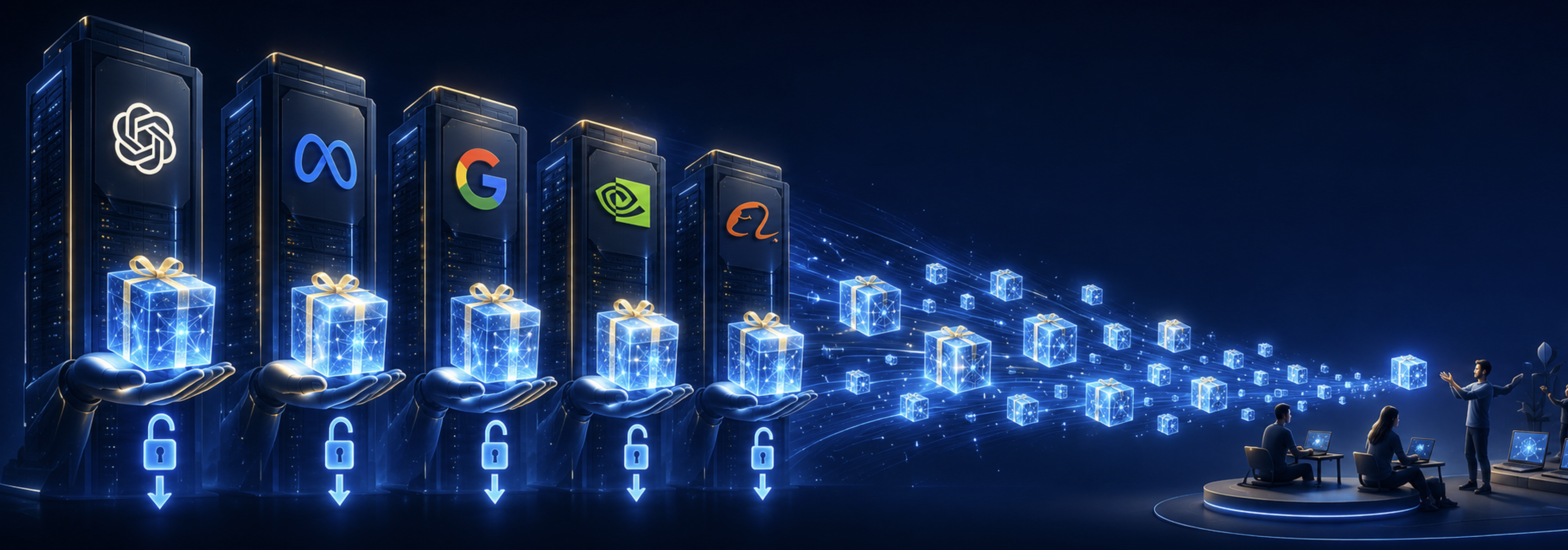
I was genuinely confused about this one, so I decided to write a blog post abotu it to force myself to do the research.
Alibaba, Meta, Mistral, DeepSeek and Nvidia have all spent enormous sums training AI models, and then let anyone with a fast internet connection download them for nothing. That is not how software companies normally behave. "They're being generous" was not a satisfying explanation, and neither was "they haven't worked out how to monetise it yet".
There are five business reasons. None of them are charity.
First, "open source" and "open weight" are not the same thing
Two different things get called open source here, and the difference is worth getting straight.
The licence on the weights often is genuinely open source. Qwen's current models are Apache 2.0, DeepSeek ships weights and code under MIT, and most of Mistral is Apache 2.0. Those are OSI-approved licences, so you can use, modify and redistribute them commercially. Llama is the exception. Its Community Licence makes anyone above 700 million monthly active users ask Meta for permission, which is why both the Open Source Initiative and the Free Software Foundation say it is not open source, whatever the marketing says.
The model itself is a different question. Open source in the sense the OSI defined for AI in 2024 means you also get the training code and enough detail about the data to rebuild and audit the thing. Almost nobody ships that. OLMo does. Qwen, DeepSeek, Llama and Mistral do not.
So the accurate description of most of these is permissively licensed open weights. You can run it and change it, you just cannot reproduce it or see what went into it. And a permissive licence today is not a permissive licence forever, which becomes important at the end of this post.
1. Give away the model, sell the cloud
This is Alibaba with Qwen.
Making Qwen free makes it popular. But most businesses do not actually want to buy GPUs, configure inference servers, tune quantisation and manage scaling. So Alibaba says, in effect, "Qwen is free. Would you like us to run it for you?"
Alibaba Cloud then sells the compute, the managed APIs and the enterprise services around it. Linux is free and Red Hat sold the convenient enterprise version. Same shape, thirty years later.
2. Commoditise your competitor
This is Meta, and it is the most interesting of the five.
Meta does not make money selling inference. It makes money from Facebook, Instagram, WhatsApp and advertising. So there are two possible futures for them. In the first, the world's AI layer is controlled by OpenAI, Google and Anthropic, and Meta has to buy access on someone else's terms. In the second, frontier-quality AI is a commodity that everyone can run.
Meta strongly prefers the second. If they spend billions on Llama and the market price of intelligence collapses as a result, that is a fantastic investment, because Meta's profits live higher up the stack.
Google did the same thing with Android. Google never needed licensing revenue from it. It needed the mobile operating system not to become a toll booth owned by Apple or Microsoft.
3. Free software, paid enterprise product
This is closer to Mistral.
A developer downloads the model and plays with it on a laptop for nothing. Then a bank says, "we need this running for 8,000 staff, hosted in Europe, integrated with our systems, monitored, secured, supported and covered by an SLA."
That second conversation is where the invoice appears. Red Hat again, with API consumption bolted on.
4. Give away the weights, sell the convenience
This is DeepSeek. Self-host if you like, or just call the API.
The counterintuitive part is that open weights make the API easier to sell. A CTO can approve it knowing that if the price triples, they can host the model themselves. That kills the lock-in objection, which is usually the thing that stalls procurement.
I understood this model as it's also the business model of SSW's CMS: https://tina.io
5. Become the standard
The last one cuts across all of them: developer mindshare.
Once millions of developers build on your model, inference engines optimise for it, hardware vendors benchmark against it, fine-tuning tools support it, tutorials teach it and consultants already know it. Alibaba has effectively recruited the internet as its ecosystem team, and Qwen has now passed 700 million downloads on Hugging Face.
That is very hard for a closed model to replicate at any price.
What this means when you are buying
My advice is to treat open weights as negotiating leverage rather than as a way to save money.
Being able to say "we could run this ourselves" changes a renewal conversation. Actually running it is a different matter. A frontier-scale open model needs expensive hardware, real engineering and someone on call at 2am, and for most teams that costs more than the API it replaced. Free weights are not free intelligence.
Be aware too that the free part is will likely end. Alibaba is reportedly about to require large commercial users of its next Qwen model to share revenue, following Moonshot, whose Kimi K3 licence requires anyone reselling it as a service above $20m a year to negotiate terms, reportedly up to a 30% share. Read the licence before you build a product on top of one of these.
What it means for the closed labs
This is the bit I had not thought through.
OpenAI and Anthropic price on exclusivity. If you want their best model, you go through them, and that is what supports the margin. Open weights break that, because once the weights are public, any cloud provider can host the same intelligence and compete on price and latency instead.
You can see it in who is arguing which side. In July, Nvidia, Microsoft, Meta, Palantir and dozens of others signed a letter backing the open-weight ecosystem, later joined by Google and OpenAI. Anthropic did not sign. How a company makes money is a very good predictor of its position on this.
The closed labs have two answers. Keep the frontier gap wide enough that the best work still has to come to them, and move the margin up into the application layer, where the product rather than the model is what you are paying for. Both are happening now, and both are being attempted while those companies prepare for public listings.
What's next?
I think we are entering a second phase. Phase one was use openness to win distribution. Phase two is selectively monetise the people who won the most from it.
So if you are making a build-or-buy call on AI this year, plan for the model layer to keep getting cheaper and the layer around it (hosting, integration, governance, the actual product) to be where the cost and the value both end up. That is also where your team's work is worth the most, which is the good news buried in all of this.
I have written before about how this changes the way we charge for work in The Problem With Billing by the Hour When Agents Do the Work, and about getting practical value out of these tools in Cognitive Offloading with AI.