
This is a message for employees who want to be more effective, more useful, and harder to ignore.
There is a growing mismatch in most organisations. Individual capability has expanded rapidly, while job descriptions have stayed mostly the same. AI is the reason.
For a long time, we talked about the idea of the “10× developer.” Someone who could produce ten times the output of their peers. This was usually attributed to rare talent, deep experience, or some hard-to-define brilliance. Something you either had or didn’t.
What’s changed is not the people. It’s the tools.
AI has significantly lowered the cost of thinking, drafting, exploring, and prototyping. Ordinary, capable people can now do things that previously required specialists, or at least permission. As a result, “10×” is no longer a property of a role. It’s a property of leverage.
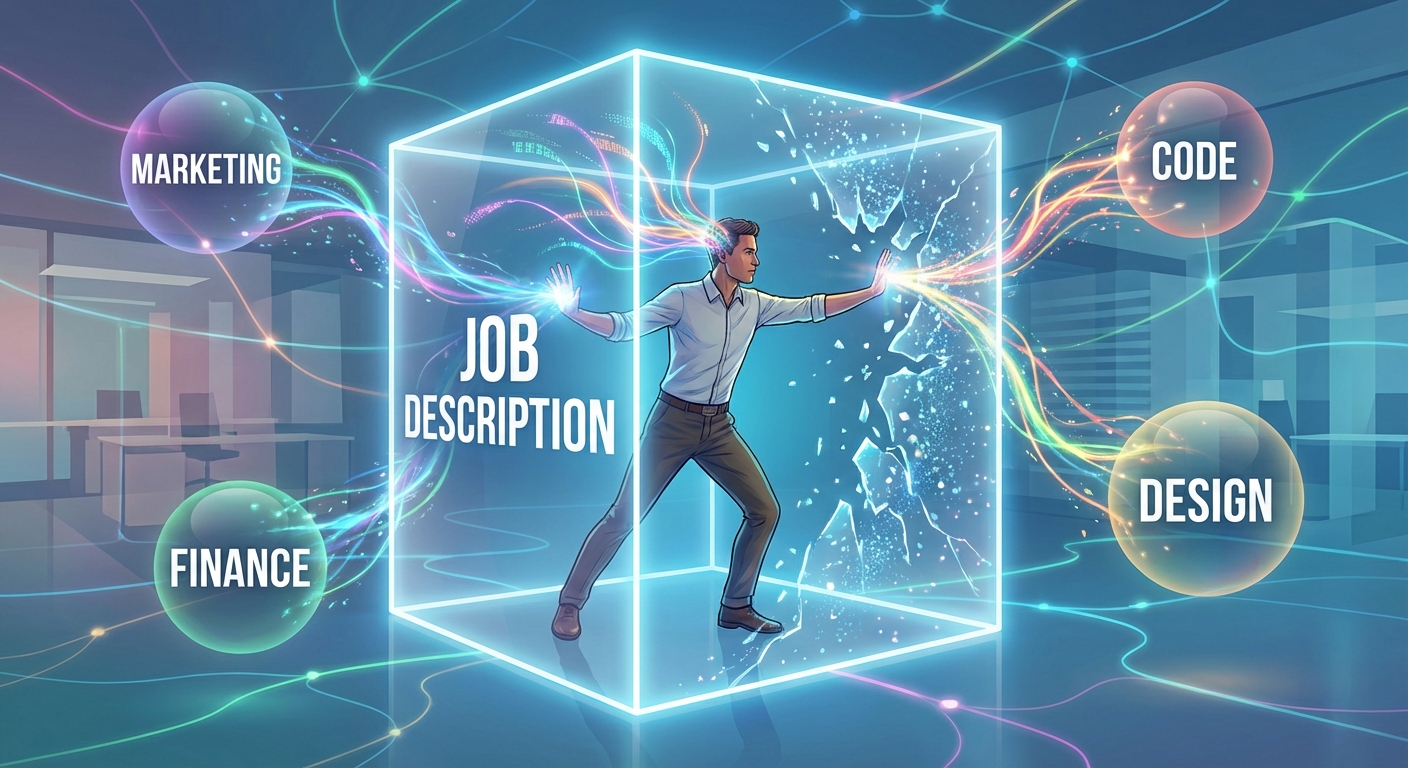
Your role is no longer the boundary
AI allows you to contribute outside your formal job description. That’s the shift.
You don’t need a promotion. You don’t need approval. You don’t need to become an expert.
In practice, this already looks like sales people drafting marketing copy, HR staff sketching simple financial models, designers reasoning about technical constraints, and developers producing rough UX concepts themselves.
None of these people suddenly mastered a new discipline. They just got far enough to be useful.
The people who benefit most are not the most technical. They are the ones who default to a simple question:
“How could AI help me think about this first?”
Thinking AI-first by default, not as an afterthought, is what creates a 10× employee.
If you want to outperform others, you don’t start by working harder. You start by assuming that for most problems, AI can help you explore options, draft a first pass, or challenge your thinking before you do anything else. Ten-times performance now comes from leverage, not effort.

10× is about range, not speed
Most AI discussions focus on speed: faster emails, quicker reports, shorter cycles. That misses the bigger change.
The real gain is range.
AI collapses the cost of trying things outside your lane. You can explore sales, marketing, product, operations, and engineering at a basic level. When you do that, you start to see connections that siloed roles often miss.
That’s where disproportionate value comes from.
The mess is expected
AI-driven work often looks messy. Half-finished scripts. Rough prototypes. Tools that work just well enough. Experiments that never ship.
This is not inefficiency. It’s learning.
The cost of experimentation has dropped. The cost of waiting has increased. Even technical debt means less than it used to, because tools improve fast and cleanup is cheaper than it once was.
Not experimenting is now the riskier choice.
This isn’t about replacing you, it’s about expanding you
AI is not here to replace you. It’s here to expand the space you can operate in.
It fills in gaps just enough for you to step into adjacent problems. You don’t need to be a marketer to add marketing value. You don’t need to be an accountant to notice financial patterns.
Humans are still doing the important part: connecting ideas, applying judgement, and deciding what matters.
What to do next, if you want to be a 10× employee
You don’t need a strategy document or permission from leadership.
You can start now:
- Default to AI-first thinking for most problems.
- Use AI to explore adjacent areas, not just your core role.
- Bring half-formed but thoughtful ideas, not polished perfection.
- Treat experimentation as part of your job, not a distraction from it.
- Measure yourself by the value you create, not the box you sit in.
The people who will stand out over the next few years will not be the ones who stayed neatly inside their lane.
They will be the ones who expanded it.
Think AI-first.
Act broader than your job description.





 The Chief Operating Officer