
• About

The Chief Operating Officer

The Chief Operating Officer

Tag Archives: artificial-intelligence

Get your head in the game: The rise of the 10× employee

11 Thursday Dec 2025

Posted by Ulysses Maclaren in Management

≈ Leave a comment

Tags

ai, artificial-intelligence, chatgpt, technology

This is a message for employees who want to be more effective, more useful, and harder to ignore.

There is a growing mismatch in most organisations. Individual capability has expanded rapidly, while job descriptions have stayed mostly the same. AI is the reason.

For a long time, we talked about the idea of the “10× developer.” Someone who could produce ten times the output of their peers. This was usually attributed to rare talent, deep experience, or some hard-to-define brilliance. Something you either had or didn’t.

What’s changed is not the people. It’s the tools.

AI has significantly lowered the cost of thinking, drafting, exploring, and prototyping. Ordinary, capable people can now do things that previously required specialists, or at least permission. As a result, “10×” is no longer a property of a role. It’s a property of leverage.
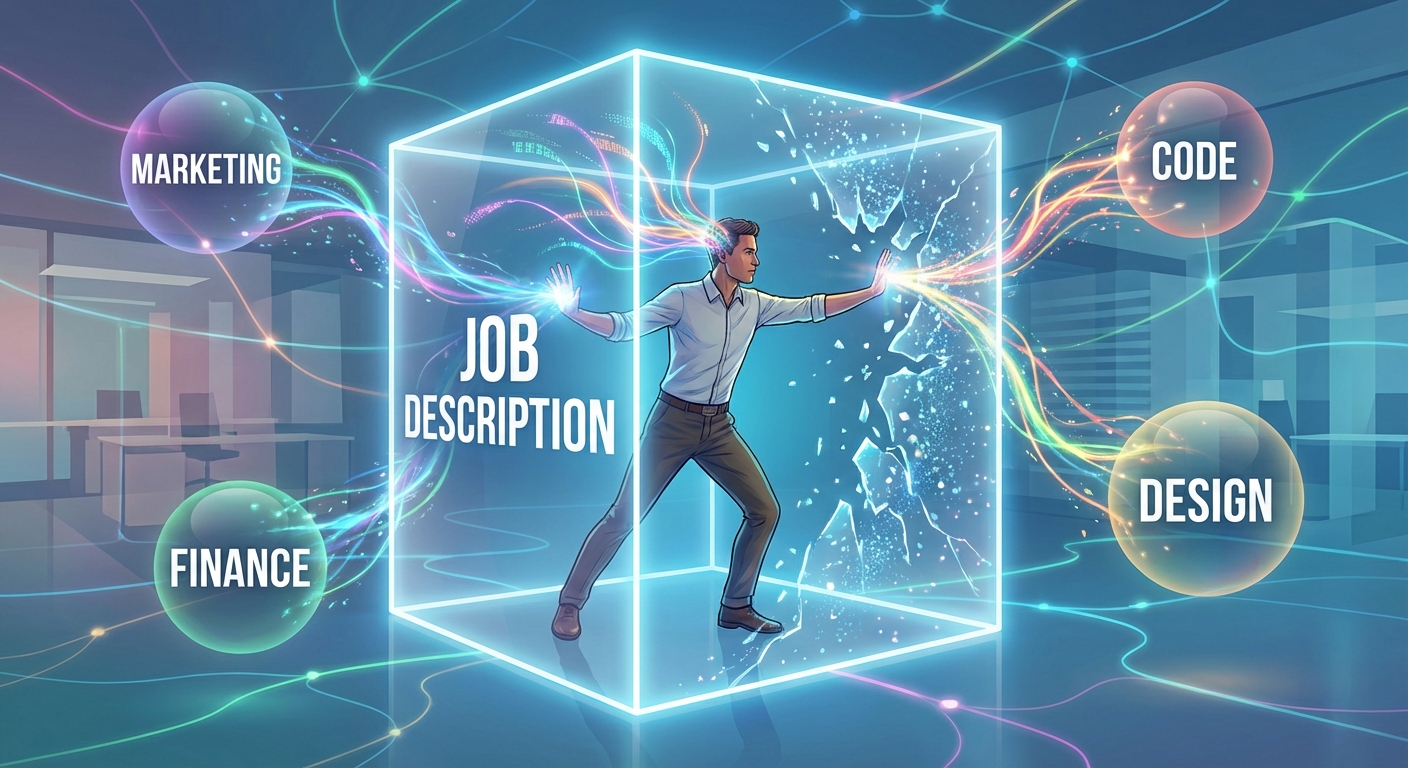
Your role is no longer the boundary

AI allows you to contribute outside your formal job description. That’s the shift.

You don’t need a promotion. You don’t need approval. You don’t need to become an expert.

In practice, this already looks like sales people drafting marketing copy, HR staff sketching simple financial models, designers reasoning about technical constraints, and developers producing rough UX concepts themselves.

None of these people suddenly mastered a new discipline. They just got far enough to be useful.

The people who benefit most are not the most technical. They are the ones who default to a simple question:

“How could AI help me think about this first?”

Thinking AI-first by default, not as an afterthought, is what creates a 10× employee.

If you want to outperform others, you don’t start by working harder. You start by assuming that for most problems, AI can help you explore options, draft a first pass, or challenge your thinking before you do anything else. Ten-times performance now comes from leverage, not effort.

10× is about range, not speed

Most AI discussions focus on speed: faster emails, quicker reports, shorter cycles. That misses the bigger change.

The real gain is range.

AI collapses the cost of trying things outside your lane. You can explore sales, marketing, product, operations, and engineering at a basic level. When you do that, you start to see connections that siloed roles often miss.

That’s where disproportionate value comes from.

The mess is expected

AI-driven work often looks messy. Half-finished scripts. Rough prototypes. Tools that work just well enough. Experiments that never ship.

This is not inefficiency. It’s learning.

The cost of experimentation has dropped. The cost of waiting has increased. Even technical debt means less than it used to, because tools improve fast and cleanup is cheaper than it once was.

Not experimenting is now the riskier choice.

This isn’t about replacing you, it’s about expanding you

AI is not here to replace you. It’s here to expand the space you can operate in.

It fills in gaps just enough for you to step into adjacent problems. You don’t need to be a marketer to add marketing value. You don’t need to be an accountant to notice financial patterns.

Humans are still doing the important part: connecting ideas, applying judgement, and deciding what matters.

What to do next, if you want to be a 10× employee

You don’t need a strategy document or permission from leadership.

You can start now:

  1. Default to AI-first thinking for most problems.
  2. Use AI to explore adjacent areas, not just your core role.
  3. Bring half-formed but thoughtful ideas, not polished perfection.
  4. Treat experimentation as part of your job, not a distraction from it.
  5. Measure yourself by the value you create, not the box you sit in.

The people who will stand out over the next few years will not be the ones who stayed neatly inside their lane.

They will be the ones who expanded it.

Think AI-first.
Act broader than your job description.

Cognitive Offloading with AI: Clear Your Mind, Boost Your Productivity

07 Wednesday May 2025

Posted by Ulysses Maclaren in Management

≈ Leave a comment

Tags

ai, artificial-intelligence, mental-health, philosophy, technology

Ever find yourself mentally juggling too many tasks? Meetings, deadlines, follow-ups – the list seems endless. Cognitive overload happens when you push your brain to handle more information than it comfortably can, leading to reduced effectiveness and unnecessary stress. Fortunately, there’s an elegant solution: Cognitive offloading with AI.

What is Cognitive Offloading?

Cognitive offloading is simply delegating mental tasks to external tools to free your mind from excessive cognitive load. Traditionally, we’ve done this with simple tools – calendars, to-do lists, and reminder apps. Now, powerful AI tools offer next-level cognitive offloading, managing complex mental tasks far beyond basic scheduling.

Why Cognitive Offloading Matters

  1. Improved Focus
    By handing off mundane or repetitive tasks to AI, your mind can zero in on higher-value work – like strategy or creative problem-solving.
  2. Reduced Mental Fatigue
    Decision fatigue accumulates throughout your day. Delegating small decisions (“What’s the best phrasing for this email?”) conserves mental energy for big-picture thinking.
  3. Better Quality Outputs
    AI handles routine work reliably. An AI assistant won’t overlook small but critical details, making sure your outputs are consistently high-quality.

How to Use AI for Cognitive Offloading

Emails and Communication

  • Drafting Emails: Tools like ChatGPT can rapidly produce clear, effective drafts. Adjust the AI-generated content as needed, but you’ll start from a strong baseline.
  • Summarising Conversations: AI meeting assistants summarise lengthy conversations, capturing essential action items without taxing your memory.

Task Management

  • Prioritisation: AI-powered task managers automatically highlight what’s urgent and what’s important, freeing your mind from constantly reassessing priorities.
  • Reminder Automation: AI reminders prompt you proactively, reducing anxiety about forgetting tasks.

Decision Support

  • Information Synthesis: AI quickly analyses large data sets, delivering insights you can use to make informed decisions without drowning in details.
  • Creative Idea Generation: AI tools like Claude or ChatGPT can suggest multiple options quickly, kickstarting your creative thinking without heavy initial cognitive effort.

Practical Steps to Start Cognitive Offloading

  1. Identify Repetitive Tasks: Audit your weekly activities—flag tasks that don’t require your unique perspective or creativity.
  2. Choose AI Tools Wisely: Not every AI tool fits every situation. Select tools that integrate smoothly into your workflow.
  3. Test and Refine: Experiment with AI assistance in small tasks initially. Gradually increase reliance as trust grows.

The Bottom Line

Embracing cognitive offloading with AI doesn’t mean relinquishing control. Instead, it’s about intelligently leveraging technology to clear your cognitive runway. With AI taking care of routine tasks, your mind is free for strategic thinking and innovation.

Clear your mind, boost your productivity, and let AI handle the cognitive clutter.

Blog at WordPress.com.

  • Subscribe Subscribed
    • The Chief Operating Officer
    • Already have a WordPress.com account? Log in now.
    • The Chief Operating Officer
    • Subscribe Subscribed
    • Sign up
    • Log in
    • Report this content
    • View site in Reader
    • Manage subscriptions
    • Collapse this bar
 

Loading Comments...